
Tutorials
IJCRS2026 will host the following Tutorials:
- Fuzzy Relational Calculus as a Fundamental yet Powerful Concept – Martin Štěpnička
- fcaR: FCA for Knowledge Extraction in Real-World Environments – Ángel Mora
- GrC Techniques on Simple Undirected Graphs – Federico Infusino
- Rule-Driven Pattern Discovery Across Data Representations – Beata Zielosko
- Modal Logic for Multigranulation Rough Set Models – Mohua Banerjee
Fuzzy Relational Calculus as a Fundamental yet Powerful Concept

Introduction
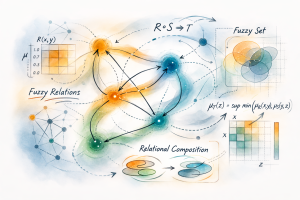
Fuzzy set theory introduced a mathematically precise way of handling graded membership and vague concepts, providing a flexible framework for modeling situations where sharp boundaries are neither available nor desirable. From its earliest formulations, the theory has supported a wide spectrum of extensions aimed at representing structured information and graded relationships between objects.
Within this broader framework, fuzzy relations arise as natural generalizations of classical relations, enabling the formal representation of dependencies, constraints, and interactions in a graded setting. Fuzzy relational calculus builds on this idea by treating relations as fundamental objects of study and by providing systematic mechanisms for constructing new relations from existing ones through well-defined operations. An important part of the tutorial is devoted to fuzzy relational compositions, which naturally emerge within this framework as key mechanisms for relating and propagating information between relational structures. These compositions form a bridge between elementary relational descriptions and more complex constructions, allowing the development of models that are expressive, transparent, and easy to interpret. By embedding fuzzy relational compositions into a broader relational calculus, the tutorial clarifies their role and significance within the general landscape of fuzzy relational modeling. Several potential applications and applicational areas are also presented.
This tutorial presents fuzzy relational calculus as a foundational framework for working with fuzzy relations. Emphasis is placed on the principles governing relational constructions and on how different design choices influence the expressive power and behavior of the resulting models. Links to Rough Sets Theory are also provided. Although the two theories are motivated differently, they exhibit an extremely rich overlap in the mathematical concepts and tools they employ, which creates a unique potential for inheriting results from one to the other.
Organizer: Martin Štěpnička
Martin Stepnicka received his habilitation (Docent – Associative Professorship) in Applied Mathematics at the University of Ostrava in 2012. Since March 2023, he is the Vice-rector for Research and Artistic Activities at the University of Ostrava. Beforehand, he served as the Director of the Centre of Excellence IT4Innovations – Institute for Research and Applications of Fuzzy Modeling, University of Ostrava for two years and he held the vice-director and senior researcher position in the preceding years. Martin Stepnicka also held the positions of the President of the European Society for Fuzzy Logic and Technology (EUSFLAT) for two consecutive terms – elected in 09/2017 and re-elected in 09/2019.
He is an Area Editor of JCR journals Fuzzy Sets and Systems, International Journal of Approximate Reasoning, and International Journal of Computational Intelligence Systems, and furthermore, an editorial board member and guest editor member of other journals. His research interests mainly include fuzzy modeling, especially fuzzy inference systems and fuzzy relational calculus. His research in this area led to the FUZZ-IEEE Best Paper Award in 2016 (Vancouver, Canada) for the paper “On the Satisfaction of Moser-Navara Axioms for Fuzzy Inference Systems”.
fcaR: FCA for Knowledge Extraction in Real-World Environments

Introduction
Formal Concept Analysis (FCA) has become a mathematical data analysis tool that enables the extraction of concept hierarchies and implications from relational data. The core of FCA lies in lattice theory and logic.
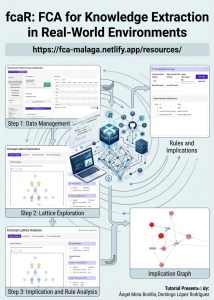
Despite its theoretical robustness, its application in production environments and real-world problem solving is often limited by the complexity of the available tools. In this seminar, we will explore how the fcaR package for the R language simplifies the workflow by providing an integrated ecosystem for the creation, manipulation, and visualization of formal contexts, concepts, and implication sets.
Through practical use cases, we will demonstrate how fcaR makes it possible to transform raw data into knowledge. We will see how to identify hidden structures in data and perform classification and recommendation tasks based on rules. The aim is for participants to understand not only the underlying theory of FCA, but also how to implement computationally efficient solutions for data analysis and knowledge discovery using this package.
Organizer: Ángel Mora
Ángel Mora is Associate Professor at the Department of Applied Mathematics in the University of Málaga, Spain. He is also Deputy Director of the School of Computer Engineering for Companies since 2020.He has published more than hundred papers on formal methods based on logic and algebra, with a particular focus on Formal Concept Analysis. In particular, one of the most intensive goals today is the development of a logic of simplifications for implications and rules extracted from data sets, which enable the development of automated methods for reasoning and explaining the results obtained.
He has also developed in collaboration an FCA package called fcaR (see https://fca-malaga.netlify.app/resources/ – over 40M downloads), which is widely used as a tool for solving real-world problems in FCA.
GrC Techniques on Simple Undirected Graphs
Introduction
Organizer: Federico Infusino
Rule-Driven Pattern Discovery Across Data Representations

Introduction
Organizer: Beata Zielosko
Beata Zielosko works as an Associate Professor at the University of Silesia in Katowice. She is the head of the research group dealing with decision rules in knowledge discovery and representation. From October 2022, she has served as deputy director of the Institute of Computer Science at the Faculty of Science and Technology of the University of Silesia in Katowice. From 2011 to 2013, she worked as a senior research scientist at the King Abdullah University of Science and Technology in Saudi Arabia.
Beata Zielosko is a co-author of four research monographs published by Springer and over 60 papers published in journals and international conference proceedings. She is also a co-editor of the PP-RAI 2025 and IJCRS 2017 proceedings and co-editor of an international monograph on feature selection. She is a member of the International Rough Set Society, KES International and the Polish Artificial Intelligence Society. Her research interests include pattern recognition, knowledge discovery, feature selection, rough sets methods for data processing and artificial intelligence.
Modal Logics for Multigranulation Rough Set Models